Maybe you’ve been reading up on digital printing. Maybe you searched for digitally printed pouches, or digitally printed labels, and landed here. Either way, here’s the thing we tell every brand that comes to us: it’s not really about the technology. It’s about the problem you’re trying to solve.
And the problem usually looks something like this:
- Six different core SKUs.
- Four regional compliance variants.
- Two limited-edition holiday launches in the pipeline.
- One co-branded flavor ready to launch.
- Quantities for each demanding different size runs.
If you relate to any (or all!), you aren’t alone. It’s a scenario we see all the time. And it’s one we’ll continue to see as CPG brands lean more into renovations of their existing portfolio versus net new innovations. As of early 2024, two-thirds of global product launches were line extensions, reformulations, or simply packaging redesigns.
While this portfolio approach can simplify matters in R&D, it raises new challenges within packaging strategies. Brands have to be able to iterate quickly across flavors, formats, compliance requirements, and regional details. If you’re like many of the brands we partner with, you can likely already see production timelines stretching out and warehouses filled with different versions of your packaging.
This is the space digital printing was built for: fast turnaround, no minimums, short runs, and every version you need — without the cost and lead time of treating each one as its own job.
“Digital printing allows you to move from one unit to the next without any setup, plates, or physical elements — it’s all digital files that can be transformed and changed on the fly. A typical job can be 500 copies of something, then move to a different version — another flavor, a different SKU. There are no limits or minimums.”
— Tomer Levin, Web-to-Print Product Manager, Belmark
The role of digital printing in your packaging program.
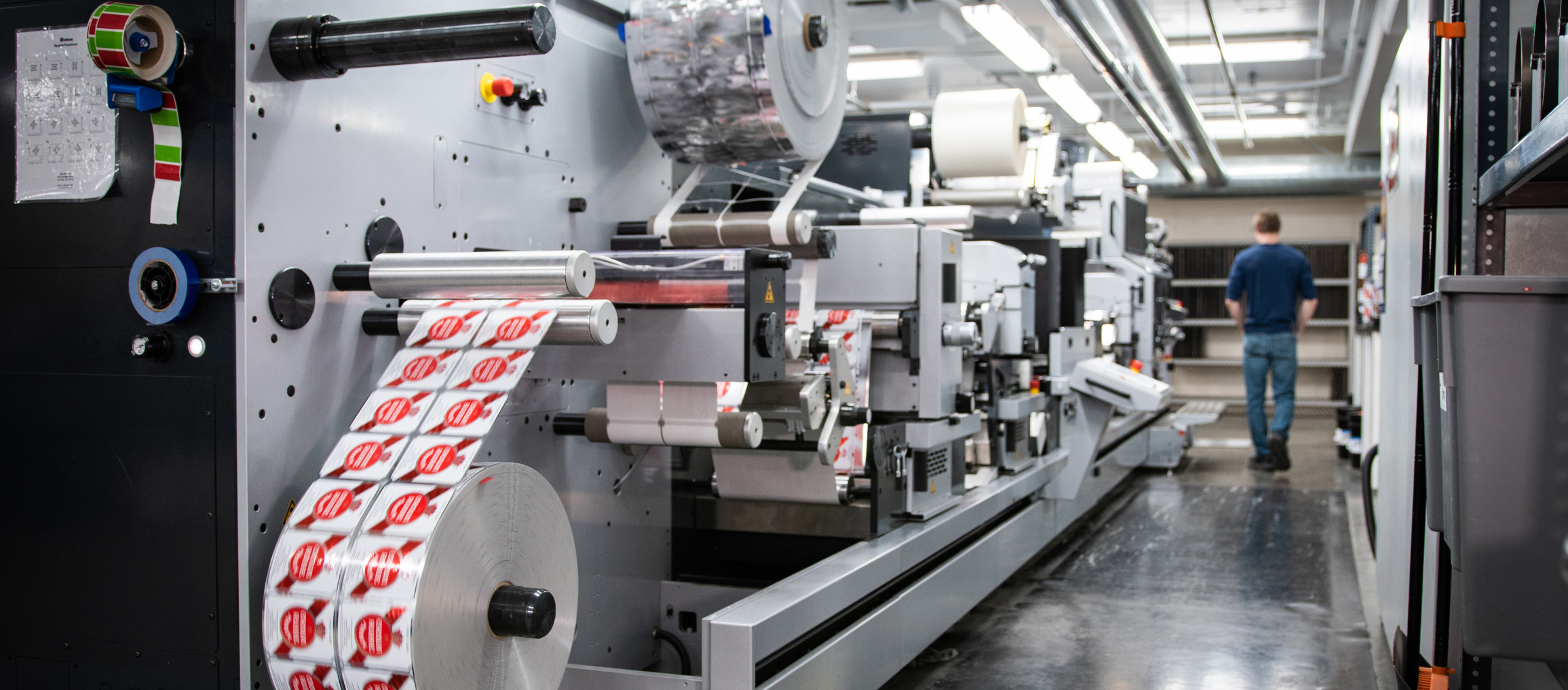
Digital printing is exactly what it sounds like: a process that works entirely from digital files, with no plates. That means you can move from one version to the next — different flavor, different SKU, different format — within a single run, without stopping the press. A job might be 500 units of one version followed immediately by 200 units of another. Each can look entirely different. No minimum quantities. No waiting.
At its most basic, this might mean printing sequential lot codes and expiration dates on a run of pressure sensitive labels. But its real value shows up when a brand needs to move quickly across a portfolio — running multiple SKUs, flavors, and regional versions together, or tailoring packaging for a specific event, territory, or audience without spinning up a separate production job for each.
Start small. Scale without limits.
Here’s what makes digital printing genuinely powerful: it lets you start small, with almost no risk.
You don’t have to commit to a massive run to find out whether a new flavor, format, or regional test is going to work. You produce only what you need for your current distribution — a few hundred units, a single market, one seasonal push — and you learn from real shelves before you scale. If it works, you grow. If it doesn’t, you haven’t buried yourself in obsolete inventory.
That low-risk entry point matters most when you think about what comes next. A SKU that starts as a small regional test can become a national program. A limited-edition run can turn into a permanent line. When that happens, you shouldn’t have to change partners, re-engineer your artwork, or start the sourcing conversation over from scratch.
This is where Belmark is different. Most packaging suppliers do one thing — they’re a digital shop, or a conventional shop, a label house, or a film house. We’re not. We run digital printing alongside conventional printing across labels, pouches, flexible film, shrink sleeves, and folding cartons, and we’ve been doing it for more than 25 years. So when your volume grows to the point where conventional printing makes more sense for a particular program, that transition happens under one roof, with no disruption to your brand or your timeline.
You get the easy, low-risk way in — and a clear path to anything you might need down the road, whether that’s a single run or many millions of labels, pouches, or cartons.
The question of consistency.
One of the most common concerns that comes up early on in digital printing discussions is that of brand consistency. If you’re running different artwork across each unit, how is it possible to protect color accuracy and shelf quality across the run?
It’s an important question to ask — and the answer is: just because the content changes doesn’t mean production standards will. At Belmark, digital printing jobs run through the same color and quality management systems as any conventional run.
When you’re managing multiple formats — pressure sensitive labels, flexible film, folding cartons — across a single brand, that consistency conversation becomes even more critical. Managing brand requirements across formats is far simpler when all of them come from one partner. One conversation, one data standard, one brand governance process applied consistently across every format. It’s the same advantage that lets you move between technologies without risk: everything stays connected, because everything lives in one place.
One more possibility: variable data printing
At the far end of what digital printing makes possible is variable data printing (VDP) — and while it’s only the right fit for specific needs, it’s worth knowing it’s on the table.
Where a standard digital run might produce several versions, VDP produces units where every single one is unique. It’s most often used for track-and-trace requirements, anti-counterfeiting and security features, or highly personalized consumer experiences — think a barcode that takes each individual shopper somewhere made just for them.
“VDP is the far end of the curve. Within a run, every label is different — a different code, a different visual, a different name. Each one is one of a kind. It usually relates to a specific need: track and trace, a security feature, or a user experience so unique that the barcode takes that person somewhere specific to them and no one else.”
— Tomer Levin, Web-to-Print Product Manager, Belmark
It’s not something every brand needs. But it’s one more capability available to you when the moment calls for it — and one more reason a single, versatile partner is worth having.
It starts with a conversation.
Whatever you’re trying to solve — a label, a pouch, flexible film, a shrink sleeve, or a carton, in a run of a few hundred or a few million — the right starting point is a conversation about your needs, not a lecture about our technology.
Belmark is built for exactly the kind of staged approach that lets you start small, manage inventory, protect the brand, and deliver the right information on the shelf — then scale into whatever comes next, seamlessly. So the real question isn’t “is digital printing right for my packaging?” It’s “what are you trying to solve?” Tell us, and we’ll help you make the right call for where your brand is today, and where it’s headed.
Share This Story, Choose Your Platform!
Ready to get started?
Ready to get started?
Call 920.280.1282 or fill out this form and you’ll be in touch with a packaging expert in under 24 hours.
Call 920.280.1282 or fill out this form and you’ll be in touch with a packaging expert in under 24 hours.