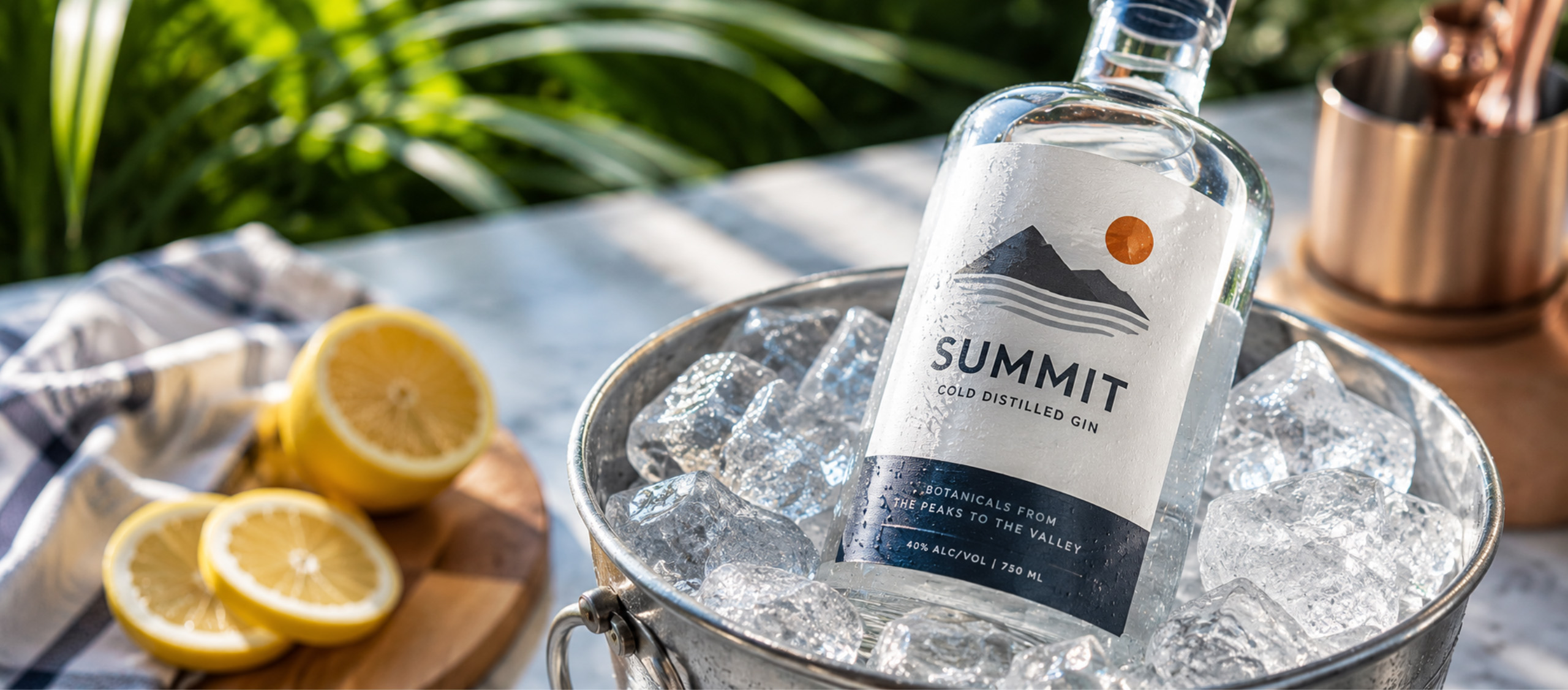
Your bottle leaves production looking exactly the way you designed it. The label is crisp, the colors are vibrant, and the finish catches the light just right. Then it spends two hours in an ice bucket at a bar, or cycles in and out of a refrigerated display case for weeks on end. What happens next depends almost entirely on how your label was engineered.
For distillery brands, nutraceutical beverages, and ready-to-drink products, cold and wet environments aren’t edge cases – they’re standard operating conditions. Labels that perform beautifully at room temperature can wrinkle, lift, or lose adhesion the moment real-world conditions set in. Understanding how to craft a label around those challenges starts with knowing what’s actually happening to your bottle at the various stages in its lifecycle.
Why Cold Environments Challenge Bottle Labels
To understand your label’s lifecycle, we have to get a little technical.
Water expands approximately 9% in volume when it freezes, and the tensile strength of common bottle plastics (like PET) can drop by more than 60% at freezing temperatures compared to room temperature. Cold environments don’t just chill a bottle – they change how every layer of it behaves.
Bottles in cold environments face a range of stress points that don’t exist at room temperature.
When a chilled bottle is brought into ambient air, condensation forms on the surface. That moisture creates a thin layer between the label and the bottle – and if the adhesive or face stock isn’t designed for it, the label can soften, shift, or lose its bond.
It gets more complex when you factor in the cycle. Bottles in refrigerated retail displays move from cold storage, to checkout, to a consumer’s refrigerator. Spirits bottles travel from warehouse to bar to an ice bucket. Each temperature change brings a new round of condensation and handling. Over time, a label that wasn’t engineered for those transitions may look significantly different by the time it reaches the consumer – or after just a few minutes on ice.
The container itself matters too. The surface, texture, and any coatings on the bottle affect how the adhesive bonds and how the label responds to moisture exposure. A label solution that works perfectly on one bottle type may behave differently on another, which is why real-world application context is part of every good packaging conversation.
Debunking the “Waterproof Label” Myth
Here’s something worth clarifying: very few labels are truly waterproof in the literal sense. What the industry often calls “waterproof” is more accurately described as engineered for moisture resistance in real-world conditions (i.e. condensation, refrigeration cycling, and handling) rather than continuous submersion.
The distinction matters because performance expectations shape purchasing decisions. A label engineered for moisture resistance may perform reliably through refrigeration and condensation cycling, which is exactly what most brands need. But the right solution is always built around what your bottle will actually experience, not a blanket claim.
Understanding your product’s environment is the right starting point. Is the bottle chilled in a refrigerator? Served over ice? Stored in a humid warehouse? Delivered through temperature-variable distribution? Each scenario creates different demands, and the label solution that performs in one may need adjustment for another.
John Gloeckler, Technical Service Engineer at Belmark, puts it this way: “We engineer custom solutions to our customer’s specific product lifecycle. If a customer has their own engineering team, we can be consultants providing situation specific expertise to fill gaps in their knowledge base. For smaller customers we can be their engineering team, doing lab testing and providing recommendations derived from over 50 years of industry experience.”
That kind of partnership, where technical guidance is part of the relationship, not an add-on, is what separates real-world label performance from generic specs.
Where Waterproof Labels for Bottles Matter Most
Moisture-resistant label performance is especially critical in three product categories:
- Distillery and craft spirits. Bottles intended for bar service routinely end up in ice or chilled displays. The label needs to stay put, stay legible, and still look premium when it’s pulled from a bucket and handed to a guest. For a craft distillery, that moment is as much a brand interaction as anything else on the packaging itself.
- Nutraceutical and functional beverages. Refrigerated storage is standard for this category, and consumers often handle bottles multiple times a day. Labels need to maintain both their appearance and adhesion through ongoing condensation exposure and repeated handling.
- Ready-to-drink products. From convenience stores to restaurant service environments, RTD beverages travel through more conditions than most products – cold displays, warm transport, and humid storage. Labels that perform well in one environment need to hold up through all of them.
Across all three categories, the common thread is that shelf quality in cold environments is brand quality. When a label wrinkles or lifts, it signals something about the product – even if the product itself is exactly as intended.
Choosing a Packaging Partner Who Understands Real-World Conditions
Packaging that performs in cold environments isn’t just about specifying the right materials. It’s about working with a partner who understands how your product actually gets used – from production through the moment it reaches a consumer.
A strong packaging partner will ask about your fill process, your distribution environment, and your end-use scenarios before recommending a solution. They’ll have the technical expertise to match material, adhesive, and finish to your specific application. And they’ll be straightforward about what will and won’t perform when conditions get challenging.
For brands at earlier stages, that kind of guidance can be the difference between a pressure-sensitive label that holds up and one that becomes a costly reorder problem. For established brands scaling into new channels, it protects brand equity that’s already been built.
Belmark works with brands across the craft beverage and ready-to-drink space – categories where cold environments are the rule, not the exception. With no order minimums, fast turnarounds, and a technical team that can function as an extension of your own, the conversation about label performance can start at exactly the right time: before it becomes an issue.
FAQs: Waterproof Labels for Bottles
Ready to make sure your label holds up — wherever your bottle ends up? Talk to the Belmark team about engineering labels for cold and wet environments.
Share This Story, Choose Your Platform!
Ready to get started?
Ready to get started?
Call 920.280.1282 or fill out this form and you’ll be in touch with a packaging expert in under 24 hours.
Call 920.280.1282 or fill out this form and you’ll be in touch with a packaging expert in under 24 hours.