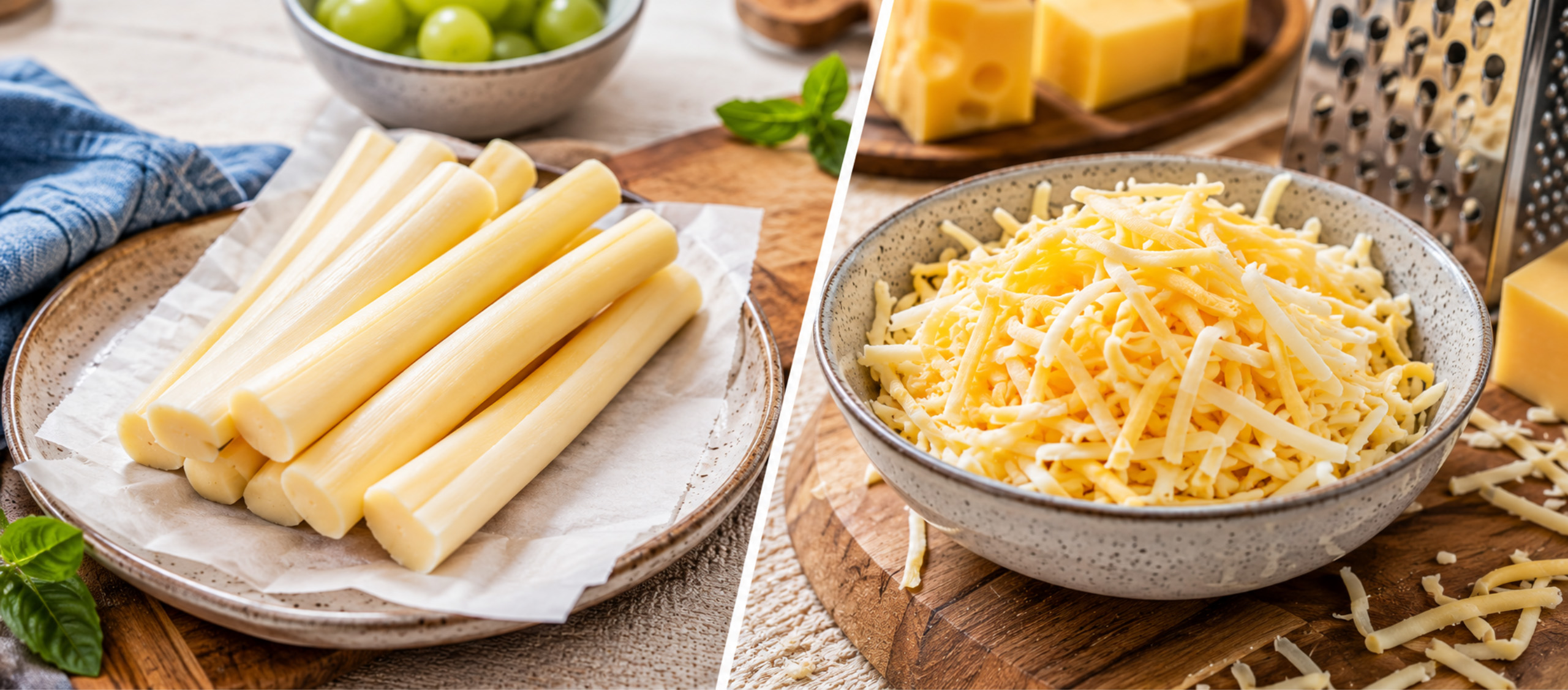
A snack stick, a resealable shredded pouch, and a block of cheese might all contain the same core product, but they’re used in completely different ways. One lives in a lunchbox or a gym bag. Another gets opened and resealed a dozen times over three weeks. The way a consumer interacts with each format is distinct, and packaging must reflect that.
For CPG dairy brands and private label cheese producers, selecting the right packaging approach isn’t just a material decision. It starts with understanding how the product is used and then designing packaging that supports that experience at every stage, from production to the refrigerator door. The dairy product packaging market is predicted to top $51 billion by 2032, a number that reflects just how much is riding on packaging decisions across this category.
Whether you’re launching a new snack stick line, scaling a shredded SKU for retail distribution, or expanding a cheese lineup that spans multiple formats, cheese packaging types are not interchangeable.
Why Cheese Format Drives Packaging Decisions
Packaging decisions don’t start with a film spec or a substrate choice; they start with the product itself. How is it eaten? Where does it go after the first opening? How long does it stay fresh? What happens to it in transit?
Shredded cheese and snack sticks represent two fundamentally different consumer relationships with the same product. That’s why a packaging partner who understands format strategy, not just materials, is so valuable when your product line begins to grow beyond a single SKU.
Packaging Priorities for Cheese Sticks
Snack sticks are built around the portion. Each serving is self-contained, and the packaging must protect it from the moment it leaves production through distribution, retail, and into the consumer’s hands.
The structural priorities are:
- Portion protection: Individual wrapping or sealed multi-pack structures keep product intact and prevent cross-contamination between servings.
- Portability: Packaging should be compact, easy to open, and appropriate for on-the-go consumption. No one wants to wrestle with a bag of snack sticks in the car.
- Distribution integrity: Snack sticks move through supply chains differently than bulk dairy. Packaging needs to hold up across temperature-controlled environments and varied handling conditions.
- Shelf and visual impact: Whether sold individually or in multi-packs, snack stick packaging carries significant branding responsibility. The format should give your design room to work.
Common formats include flow-wrapped individual sticks or flexible packaging multi-packs with reseal options for family or value sizes. The right choice depends on how the product is sold, where it lands in the retail set, and how your consumer expects to find it.
Packaging Priorities for Shredded Cheese
Shredded cheese packaging is a different challenge entirely. Here, the packaging lives with the consumer through multiple uses (often over a week or two) and it needs to maintain freshness, prevent clumping, and make dispensing easy from the first pour to the last handful.
The key performance requirements for shredded cheese packaging include:
- Re-sealability: Consumers expect to open, use, and close packaging repeatedly without product degradation or spillage.
- Moisture and oxygen control: Film selection and sealing integrity directly affect shelf life and product quality. The structure must perform at refrigerated temperatures throughout distribution and in-home use.
- Consistent dispensing: Shredded cheese packaging should allow for easy, controlled pouring. The bag’s shape, opening width, and reseal mechanism all influence how intuitive the experience feels.
- Retail presence: Stand-up pouches are the dominant selection for good reason – they’re stable on shelf, highly brandable, and efficient in terms of space.
Flexible packaging structures used for shredded cheese are also strong canvases for brand storytelling. High-quality print capabilities let dairy brands and private label producers compete for shelf-for-shelf with national names through bold color, shaped windows, and premium finishes – without changing the product inside.
Building a Flexible Packaging Strategy as Your Cheese Line Grows
The most successful dairy brands don’t just choose packaging for the product they’re launching today – they choose a packaging strategy that can grow with them. Adding a new snack stick variety, entering a new retail channel, or expanding shredded SKUs to include organic or specialty blends all create downstream packaging decisions that compound over time.
A few things to consider as your cheese line expands:
- Launching new SKUs without major operational disruption. If your packaging partner understands your fill process, your equipment, and your distribution model, adding a new format doesn’t have to mean starting from scratch. The right partner brings that operational knowledge into every new project.
- Coordinating packaging with your supply chain. Film selection, lead times, and roll stock specifications need to align with your co-packer or in-house production capabilities. Misalignment here creates delays that ripple forward to retail.
- Speed-to-market for new formats. When you’re adding a snack stick line while managing an existing shredded business, launch timelines matter. Digital printing capabilities allow for faster turns on new SKUs and market tests without the inventory commitment of a large conventional run.
- Maintaining brand consistency across formats. A consumer who recognizes your brand on a shredded pouch should recognize it immediately on a stick multi-pack. A packaging partner with cross-format capabilities helps you build that consistency without managing multiple supplier relationships.
Belmark works with dairy brands across the full range of cheese packaging types, from pressure sensitive labels for rigid containers to flexible packaging for pouches and multi-packs. Our experience across formats means we can help you evaluate trade-offs, align packaging with your production setup, and scale as your SKU count grows.
FAQs: Cheese Packaging Types
The Right Packaging Starts with the Right Questions
Cheese packaging isn’t one-size-fits-all. The brands that grow successfully in this category are the ones who treat packaging as a strategic decision, not a commodity purchase. Starting with how your product is used, then building packaging around that experience is the clearest path to getting it right.
Whether you’re navigating your first snack stick to launch, scaling a shredded line to new retail accounts, or building a multi-format dairy portfolio, the right packaging partner will ask the right questions before recommending a solution. That’s how packaging becomes an asset to your brand—not a variable that keeps you up at night.
Ready to talk through your cheese packaging strategy? Let’s connect.
Share This Story, Choose Your Platform!
Ready to get started?
Ready to get started?
Call 920.280.1282 or fill out this form and you’ll be in touch with a packaging expert in under 24 hours.
Call 920.280.1282 or fill out this form and you’ll be in touch with a packaging expert in under 24 hours.