If you’re asking whether your product needs a folding carton, something has probably changed: a new retail account, a brand refresh, or a SKU that’s outgrown its current packaging. The answer isn’t always yes. But when it is, it tends to matter more than brands expect. Here’s how to think through it.
Three Signs Your Product Might Be Ready for a Folding Carton
Most brands don’t arrive at folding cartons through a grand packaging strategy. They arrive because something shifted: a buyer asked for it, a product started looking out of place on the shelf, or you are launching multipacks for one of your SKUs.
Here are three scenarios that tend to signal it’s time to consider a carton:
- You’re moving into retail or expanding your retail footprint. Retail shelves are structured, competitive environments. Products need to stand, stack, and hold their own visually without extra support. Folding cartons are built for exactly that. They provide the structure and surface area to present your brand clearly, consistently, and professionally.
- Your product is being sold in multi-packs or bulk quantities. Many products such as supplements, snack bars, or single-serve food items are sold as multipacks as product lines extend. Not only are these a great way to get more SKUs in front of your target audience, they also make standout visuals on the store shelf.
- Your packaging presentation has outgrown your brand. There’s a version of this transition that happens quietly over time: your brand has grown, your product line has expanded, your retailer relationships have deepened, but your packaging still looks like the version you launched with two years ago. When the brand has evolved past the packaging, a carton format can close that gap. More surface area means more room to tell your story, reflect your positioning, and look like a brand that belongs on the shelf it’s trying to reach.
What we hear from brands most often: “We knew we needed something different when a buyer at a regional chain showed us what we’d be sitting next to. It wasn’t about being fancy — it was about looking like we belonged in the same aisle.” This moment happens for a lot of brands. The good news is that it doesn’t have to be a complicated transition.
What Custom Folding Cartons Actually Do on Shelf
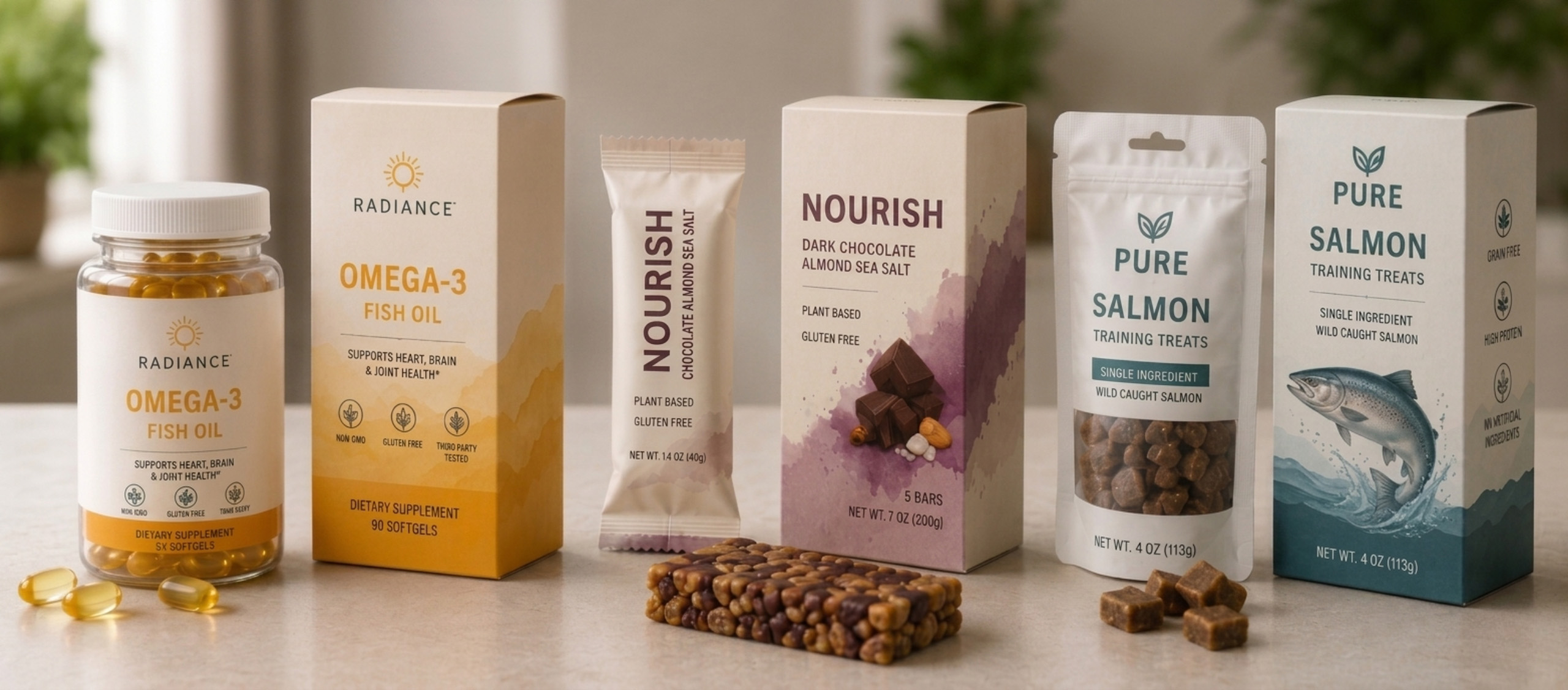
A folding carton is made from paperboard, a thick, rigid, yet lightweight material made from compressed wood pulp or recycled paper fibers, not corrugated cardboard. Think of the outer packaging for a supplement bottle, a tea kit, a pet treat pouch inside a carton, or a snack product. The format is familiar, versatile, and effective in a wide range of categories.
In the markets Belmark serves (nutraceuticals, pet food, snack, fresh produce, ready-to-eat, and others), folding cartons consistently deliver in a few key ways:
- Structure and stability. Cartons stand upright without props or support. They stack cleanly on shelves and in displays. For category buyers and retail merchandising teams, that’s a practical advantage that matters.
- Branding surface. Pressure sensitive labels work well on bottles, jars, and pouches. But when a product needs more canvas including ingredient callouts, usage instructions, certifications, brand story, or high-impact visuals, a carton gives you six panels to work with instead of one or two.
- Display flexibility. Custom folding cartons can be designed for retail shelf placement, countertop displays and e-commerce. A well-designed carton works across all of your selling formats.
- Product containment. For categories like nutraceuticals and pet, cartons create a secondary layer of protection around flexible packaging or bottles. That’s especially important for products sensitive to light, humidity, or physical handling in transit.
You don’t need to come to a first conversation with specs. Belmark’s team works alongside you to figure out what your product needs to do on shelf and which format decisions follow from that.
Folding Cartons and the Rest of Your Packaging Lineup
One of the most common assumptions brands make about folding cartons is that choosing them means replacing everything else. That’s rarely how it works.
Many Belmark customers run custom folding cartons alongside pressure sensitive labels and flexible packaging as part of a complete packaging strategy. A supplement brand might use a pressure sensitive label on the bottle and a folding carton to house it for retail. A snack brand might package products in flexible packaging and use a carton for a multi-pack of small serving size bags. These formats work together, and a good packaging partner helps you think through where each one fits.
This is also true as brands grow and expand their SKU lineup. Adding a carton format doesn’t mean walking away from what’s already working; it means adding a format that opens new distribution and retail possibilities without disrupting your existing packaging operations.
Scale Isn’t a Barrier
A lot of brands assume folding cartons are for high-volume operations. That assumption holds brands back.
Belmark works with brands at every stage, from a first-ever carton run to full-line production. There are no order minimums. If you’re testing a new retail channel with a limited run, that’s a project Belmark can support. If you’re scaling up to regional or national distribution, the same team and infrastructure are there to grow with you.
The other thing worth saying clearly: Belmark’s involvement doesn’t end when your first order ships. Your sales representative, your product manager, and your technical team stay engaged as your business evolves. When you’re building a packaging lineup across multiple formats, having a single partner who understands your full picture makes a real difference.
What to Bring to Your First Conversation
You don’t need to arrive with a spec sheet or a finished design. What helps most is a clear sense of a few things:
- Where your product is going. What retail environment or distribution channel are you targeting? Grocery, natural, specialty, e-commerce? The shelf context shapes the format decision.
- What your product needs to do. Does it need to stand on its own? Stack? Protect a flexible pouch inside? Communicate more brand information than your current packaging allows? Knowing the “what” makes it easier to work toward the “how.”
- Where your brand is headed. Packaging decisions made today should leave room for where you’re going in the next one to two years. If you’re planning a rebrand, adding SKUs, or expanding into new channels, that’s useful context from the start.
FAQs About Folding Cartons
Your Product Is Ready. Let’s Make Sure Your Packaging Is Too.
Folding cartons aren’t the right answer for every product, but for brands moving into retail, growing past their current packaging format, or looking for more structure and branding surface, they’re hard to beat. The decision doesn’t have to be complicated.
If you’re standing at that crossroads, wondering whether your current packaging is still the right fit for where your brand is headed, the next step is a conversation, not a spec sheet.
Talk to a packaging consultant and let’s figure out if a folding carton belongs in your lineup.
Share This Story, Choose Your Platform!
Ready to get started?
Ready to get started?
Call 920.280.1282 or fill out this form and you’ll be in touch with a packaging expert in under 24 hours.
Call 920.280.1282 or fill out this form and you’ll be in touch with a packaging expert in under 24 hours.