You’ve designed a great product. Now someone’s asking whether you want pressure sensitive or shrink sleeve labels — and suddenly the packaging decision feels a lot more complicated than it should.
It doesn’t have to be. The format that’s right for your product comes down to a handful of things: your container shape, how your product gets used, where it’s going, and where your brand is headed. None of those require a spec sheet to answer. They just require thinking about your product the way a shopper — and a production line — will actually encounter it.
Here’s how to think through it.
The Two Formats, Briefly — What You’re Actually Choosing Between
Before the decision, the definitions. Here’s what each format is, in plain terms.
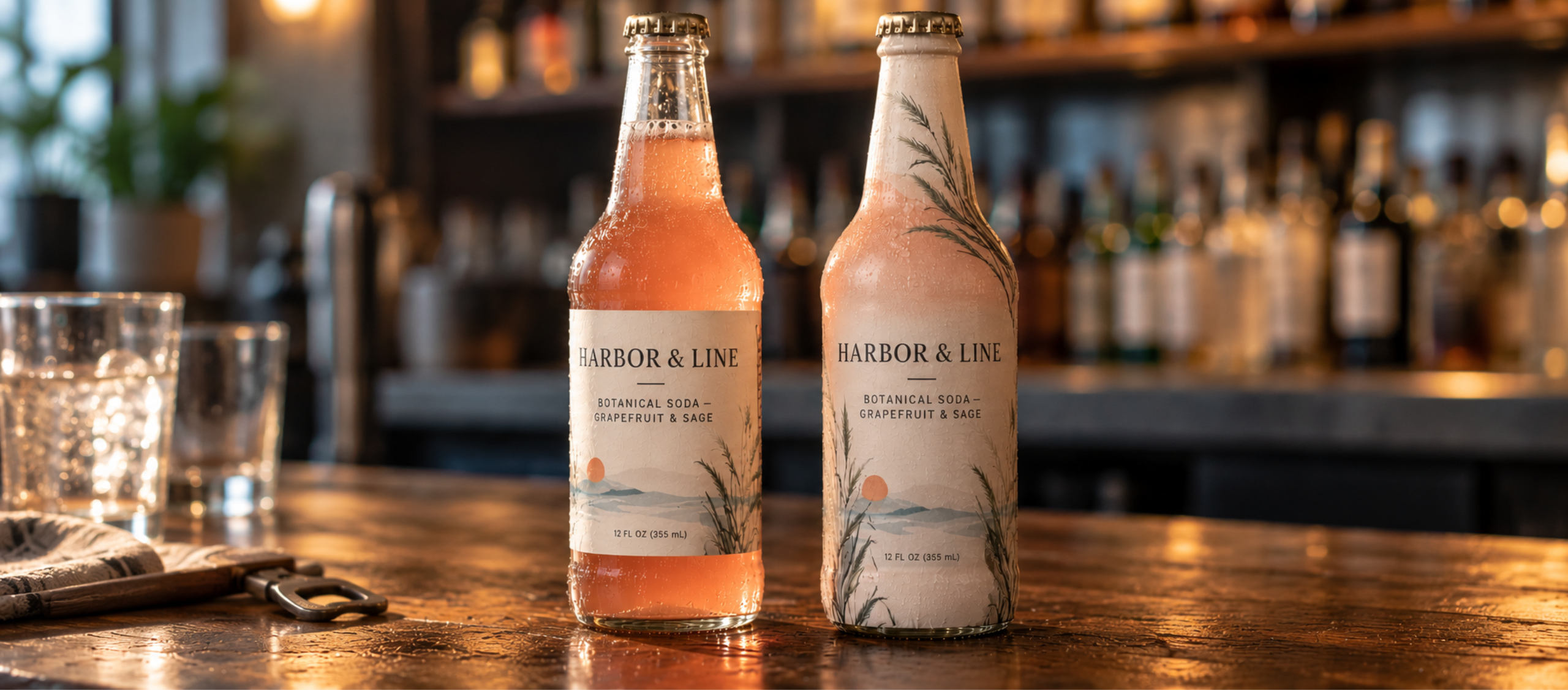
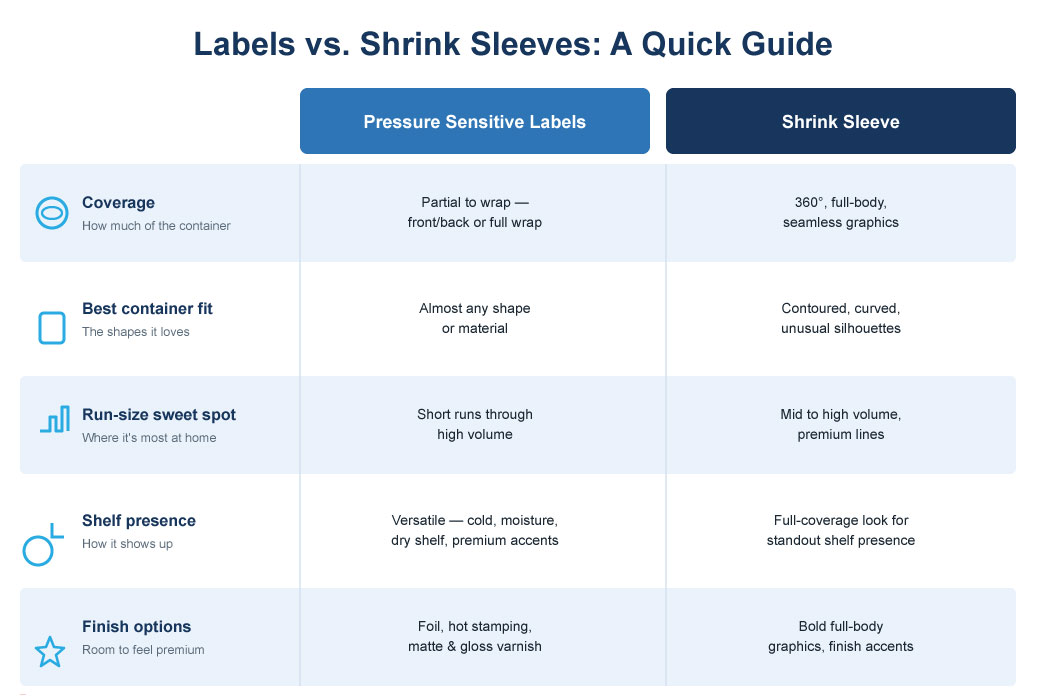
Pressure sensitive labels are the ones most people picture when they hear “label.” They’re printed, die-cut, and backed with adhesive, then applied to your container — a front-and-back pair on a bottle, a wrap around a jar, a single mark on a pouch. They work on almost any container shape and material, and they’re where premium finishes live: matte and gloss varnishes, foil, hot stamping for that high-end distillery look. If you want flexibility in shape, finish, and application, this is usually the starting point.
Shrink sleeves are printed films that slip over the container and shrink to hug its shape when heat is applied. The result is 360-degree coverage with no seams to interrupt the artwork — graphics that wrap the whole container, top to bottom. Sleeves shine on contoured bottles, unusual silhouettes, and products that want a full-body design or a tamper-evident neck band. If your container has curves a flat label can’t follow, a sleeve follows them.
Two formats, two sweet spots. The trick is matching the format to your product — not to whatever you’ve seen before.
The Real Questions That Drive the Decision
Skip the feature chart. When one of our packaging experts helps a brand sort this out, the conversation usually starts with a few plain questions — the same ones you can start asking yourself right now.
What does your container actually look like? A straight-walled jar or bottle keeps every option open. A contoured bottle or an unusual silhouette may point toward a sleeve that can follow the curves, or a pressure sensitive label shaped to fit. The container narrows the field faster than anything else.
Where does your product live? A jerky pouch in a pantry, a cheese wedge in a refrigerated deli case, a supplement bottle in a bathroom cabinet, a produce clamshell moving from a chilled truck to a grocery shelf — each environment asks something different of the label. Moisture, refrigeration, and handling all matter. A label built for the cold, for instance, behaves very differently from one that never leaves a dry pantry shelf.
How much of the container do you want to cover? A logo and a few lines of copy is one thing. A full-body wrap with edge-to-edge graphics is another. If you want the design to own the entire container, top to bottom, that pulls you toward a sleeve. If a clean front-and-back or a shaped label tells your story, pressure sensitive has it covered.
What do you want the package to feel like? Reaching for foil, hot stamping, or a tactile varnish that makes someone want to pick the product up? That’s pressure sensitive territory. Want bold graphics wrapping the whole container, or a tamper-evident neck band? That’s where a sleeve shines. Both can look premium — they just get there differently.
Are you prototyping or scaling to retail? Where you are in your growth changes the math. What makes sense for a first run headed to a tradeshow booth isn’t always what makes sense for a national rollout — and that’s exactly the point worth planning for early.
The right answer often depends on details that are easier to talk through than to read about — that’s what our packaging experts are here for.
Where Each Format Wins
Neither format is better than the other. Each one has a context where it’s clearly the right call. Here’s where each tends to shine.
Pressure Sensitive Labels
Pressure sensitive labels are the more versatile of the two, which is why so many brands start here. They fit nutraceutical and pet supplement bottles that need a clean, premium look on a crowded shelf. They wrap snack tubs, cheese packaging, and jerky pouches that move through moisture, cold, and a lot of handling. And they give confectionary and distillery brands room to reach for finishes like foil and hot stamping that make a package feel worth picking up. When you want flexibility in shape, finish, and run size — including a short run to get started — this is the format that says yes to the most situations.
Shrink Sleeves
Shrink sleeves win when the container has a shape a flat label can’t flatter, or when the design wants to own the whole surface. A contoured nutraceutical canister, a curvy personal care bottle, a specialty sauce bottle, a premium line extension that wants full-body graphics and a tamper-evident band — these are sleeve territory. If your product’s silhouette is part of its identity, a sleeve wraps that identity all the way around.
The Scaling Question Most Brands Don’t Think About Early Enough
Here’s the part most format guides skip: your label format isn’t just a decision for today. It’s a decision your growth will keep re-opening.
A lot of brands start with pressure sensitive labels — smart, because you can launch a new SKU without betting your whole budget on packaging you might tweak next quarter. Then things grow. Maybe a premium line extension calls for the full-body look of a shrink sleeve, or a new product lands in a contoured container that a flat label can’t flatter. That’s growth doing exactly what you wanted it to.
The problem isn’t the format change. It’s what usually comes with it: finding a new supplier who handles the new format, re-briefing them on your brand from scratch, and hoping your color still looks like your color once it’s coming off a different line. Managing consistent color across formats and vendors is where a lot of growing brands quietly lose time and sleep.
It doesn’t have to work that way. When one partner produces across formats, a format change is a conversation — not a fresh start. Your brand stays consistent, your color stays managed across every package, and nobody has to re-learn who you are.
That’s how Belmark is built. No order minimums, so you can start with exactly the run you need and scale when you’re ready — not when a supplier’s minimum says so. Speed-to-market, so a format change doesn’t cost you a retail window. And total packaging solutions under one roof — pressure sensitive labels, flexible packaging, and folding cartons — so as your needs grow beyond labels, the same partner grows with you. We’re built to be a packaging partner, not a vendor you have to re-hire every time your product line changes.
A Note on Sustainability
Sometimes sustainability is part of the format conversation — and when it is, it’s worth knowing there’s no format you have to rule out to make a responsible choice. Sustainable options exist for both, and choosing one doesn’t mean trading away the quality or shelf quality your product depends on.
Belmark offers sustainable options across pressure sensitive labels, flexible packaging, and folding cartons through two programs: tru-IMPACT®, which focuses on responsibly sourced materials — including FSC– and SFI-certified fiber — and post-consumer recycled content to reduce waste, and eco-READY™, which offers recyclable options across formats. Both are real choices brands make every day. Which one fits depends on your specific goals, and that’s a conversation worth having rather than a box to check.
Not Sure Where to Start? That’s What We’re Here For.
If you’ve read this far and you’re still not certain which format is right, that’s normal — and it’s a good reason to talk to someone rather than guess. The right choice comes down to your product, your container, and where you’re taking your brand. Those are exactly the details our packaging experts sort through every day, whether you’re choosing a format for the first time or rethinking the small elements that make the biggest impact on an existing line.
You bring the product and the goals. We’ll help you land on the format that fits — and produce it, from your first run to your full line. You can also explore our pressure sensitive labels to see where a lot of brands begin.
Talk to a packaging expert and we’ll sort it out together.
Share This Story, Choose Your Platform!
Ready to get started?
Ready to get started?
Call 920.280.1282 or fill out this form and you’ll be in touch with a packaging expert in under 24 hours.
Call 920.280.1282 or fill out this form and you’ll be in touch with a packaging expert in under 24 hours.