Your printer asked you for a dieline. You said you’d check with your designer, hung up, and then quietly searched for what a dieline actually is.
It’s a fair question, and it’s one of those terms the packaging industry uses constantly without ever stopping to define. So here’s the short version, and then the part that actually matters for your project.
A dieline is the shape of your package. It’s the exact outside border — the physical X and Y outline of the thing being cut out. It’s nothing more complicated than that.
A template is the dieline plus everything else your designer needs to know. The dieline is one part of a template.
What’s in a template
If a dieline is the shape, the template is the shape with all the instructions drawn around it.
A template typically includes the dieline itself, the dimensions — how tall, how wide — any corner radius, the bleed area beyond the cut edge, and the zones where copy shouldn’t go. Depending on the package, it may carry other production markings your designer just needs to leave alone.
Put together, that’s the map your designer builds on. Every element of the artwork gets positioned relative to those boundaries.
Here’s a useful way to picture the distinction. Think of a trading card. The rounded rectangle shape of the card is the dieline. The template is that same shape, plus a border showing where the bleed extends past the trim, plus the labeled measurements telling you the card is three inches by two, plus the notes about where nothing should be placed. One is a shape; the other is a shape with a full set of directions.
Every package has one
This surprises people, so it’s worth stating plainly: every package that runs on a press has a dieline. That’s true of pressure sensitive labels, flexible packaging, and folding cartons alike.
It’s easy to assume dielines are a folding carton thing, because cartons are where the concept is most visible. A carton has scores and folds and flaps, and the flat shape of one looks unmistakably like a technical drawing. But a pressure sensitive label has an outside shape too, and so does a pouch. Anything being cut, trimmed, or shaped needs that shape defined before anyone can produce it.
That’s also where the word “die” comes from. A die is the tool that does the cutting, and it gets made from the dieline — the line first, then the tool, then the package.
Why your designer can’t skip it
The reason your printer asks for a dieline before artwork starts isn’t paperwork. It’s that designing without one usually means designing twice.
Artwork built on the wrong dimensions has to be rebuilt. Artwork that ignores the safe zones has copy sitting somewhere it can’t stay. Artwork with a critical element right at the cut edge runs into problems we’d rather you hear about now than after you’ve fallen in love with the layout. All of that is avoidable by starting on the correct template.
The order that works is straightforward: get the template, then design on it. The order that causes rebuilds is designing something first and then trying to make the shape accommodate it.
If you want the full picture of what else makes a file easy to move through production, we cover that in what your printer actually needs from your designer. The template is where it all starts.
Where your dieline comes from
There are two situations here, and we handle both.
You already have one. Plenty of brands arrive with a dieline and template in hand, either from a previous print run or from their designer. Send it over. Our technical team compares it against the templates we’ve already established — we have tens of thousands of them — and if we’ve got a match, your designer can start immediately. If we don’t, we’ll create one from your dimensions quickly and in-house.
You don’t have one yet. This is more common than you’d think, especially for a first package or a new format, and it creates a genuine chicken-and-egg problem: your designer needs a shape to design on, but you haven’t settled the shape yet. That’s a normal place to be, and it’s a good moment to call us.
When you don’t know the shape yet
Here’s how that actually goes, using a project that came through recently.
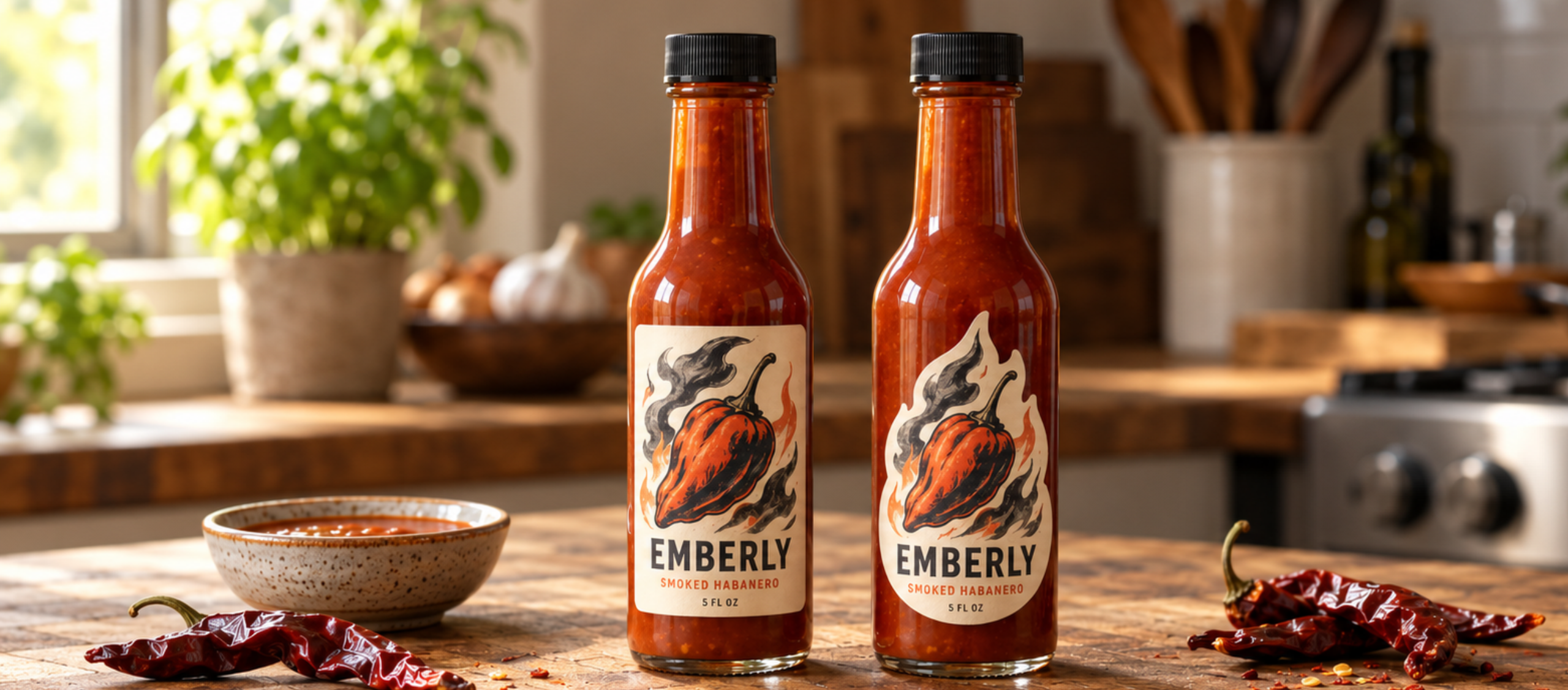
A customer was in the design phase and hadn’t decided on the shape of their label. They were weighing two directions for the top edge: a simple arch, or a more intricate crown. Both were viable, and looking at them on a screen wasn’t settling it.
So we made physical versions of both, cut by hand, and sent them over so they could look at the two side by side in the real world. They picked the crown — but they had a reasonable concern about whether something that intricate would peel cleanly. Fair point. So we softened a few of the corners on the shape, showed them the adjustment, and once they were happy with it, our technical team drew the finished dieline and sent it back to them.
Their designer then built the artwork on that dieline, finalized it, and sent it to us to produce.
That sequence is worth noticing, because it’s how the division of labor usually shakes out. We helped figure out the shape and provided the template, their designer did the design, and we manufactured the result. Belmark doesn’t create artwork — we make the packaging, and we give your designer the foundation to build on.
Which raises the question of when a new shape needs to be drawn at all.
A note on shape choices
One practical thing worth knowing while you’re deciding: starting from a shape we’ve already established is generally the faster path. With tens of thousands of templates on file, there’s a good chance something already fits your package, and choosing from what exists means your designer can begin right away rather than waiting on a new drawing.
If nothing fits, we’ll draw what you need. It just adds a step, so it’s worth raising early if your timeline is tight.
The same logic applies to sizing a carton around a product. Brands sometimes send us the actual product — a handful of units, unfilled — so our technical team can measure and bundle them and cut physical samples in a few sizes. Then you can hold them and answer the question that’s hard to answer on paper: how snug do you want this? Sometimes the answer comes from a retailer instead, when your shelf allocation caps how tall the package can be. Either way, that’s a conversation worth having before the artwork exists.
Frequently asked questions
Where Belmark fits
The dieline is a small technical thing that ends up shaping a lot of your project, which is why it’s worth getting settled early rather than discovering it late.
Belmark manufactures pressure sensitive labels, flexible packaging, and folding cartons, so whichever format you’re building, the template comes from the team that will produce the package. We don’t hold you to an order minimum, so a new shape doesn’t have to be justified by volume you don’t have yet. And settling the shape early is usually what keeps a speed-to-market timeline intact.
Call us before your designer opens a file. We’ll get you a template, tell you what to watch out for on your particular package, and stay with you from there through production and the next SKU after that.
Share This Story, Choose Your Platform!
Ready to get started?
Ready to get started?
Call 920.280.1282 or fill out this form and you’ll be in touch with a packaging expert in under 24 hours.
Call 920.280.1282 or fill out this form and you’ll be in touch with a packaging expert in under 24 hours.